Sunday, January 23, 2011

Client story: How to get cats to like each other!

The following is a blog entry from Sandi, who recently adopted a kitten from Care Animal Hospital during our most recent Lucky Paws "Adopt-a-Thon."  


I have a 1 ½ year old cat named Riley who, except for the occasional "bad bities", is an awesome cat.  I've been thinking about getting a second cat for a while and since I'm home more these days I thought--no time like the present!  I believe in trusting my gut, so I took my time finding the right kitten and was open to either a male or female.  I finally found the right kitten who was an 11 week old female.  Stella (the kitten formerly known as Tasha Yar) was part of a litter found in the wild and was fostered for several weeks by Dr. Paige Garnett.  I brought her home in a kitty carrier and triumphantly placed it in the center of the living room.  Stella's picture is shown below.  


Riley thought it was great to see the kitty carrier until he spotted Stella.  His tail and body then bushed out to twice their normal size and he began circling the carrier, his ears turned back and low.  Stella started meowing after about 20 minutes, so I took her out of the carrier to walk around...big mistake! Riley started to chase her and immediately began pouncing and biting.   I had a spare bedroom made up for Stella with her own food, water, kitty litter box and small bed.  I spent some time with her alone in her new room until she got sleepy, and then I left her in the room with the door closed.  After a minor panic attack, I immediately got on the internet and started searching for material about "integrating cats".

I discovered a great web site. It was super helpful with examples of cat body postures, pictures of actual cat integrations and very comprehensive instructions for successful integrations. These sequential steps include: isolation (from each other, not from people), scent familiarization, room swapping,  visual familiarization, developing positive familiarization, short supervised visits, separation at signs of hostility, longer supervised visits, limited free mingling and finally free mingling full time.  Additional tools that were helpful include having a spray bottle or squirt gun on hand for times that play gets too rough, lots of toys, and the use of Feliway, a natural pheromone spray that you can pick up at Care Animal Hospital.  In particular, I found it helpful to have two toys (one for each hand and cat).  This allowed each cat some supervised playtime where they didn't have to fight over an individual toy, but could still see the other cat playing and get used to them.  

I learned that the bad news was that I had mistakenly skipped right to the last step resulting in overly stressed cats.  The good news was I could begin again at step one (isolation) and follow each step (for as long as necessary) before continuing on to the next step.  In my case, I discovered it was necessary to back up and repeat the first few steps a couple of times before Riley and Stella were truly ready to continue on.

The main lesson I learned was it really takes time and patience to integrate a new cat into the home.  Cats adapt to change at their own pace. Even the most social "resident" cat can feel very threatened and resort to "warfare" tactics to protect their turf.   

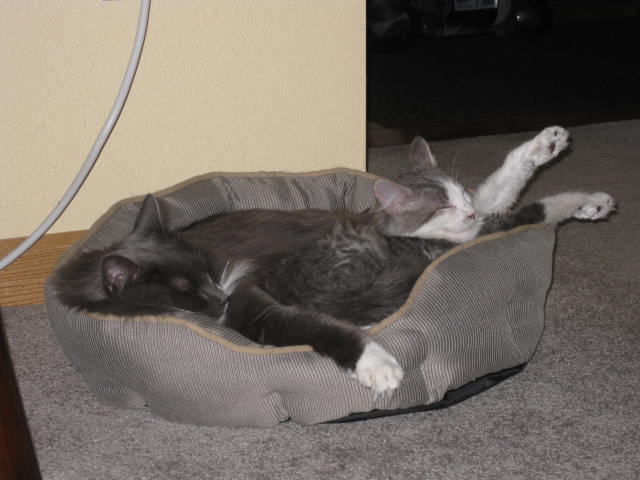
With Riley and Stella it took 3 ½ weeks to go from high stress drama to sleeping in a cat bed (together!!!!) on a cold, snowy afternoon. There were several days/weeks I thought it was never going to work out, but I'm so grateful that I stuck it out and gave each cat the necessary time to adjust.  I have to say that it's really worth the time and effort that goes into the integration process when you see them actually playing "nicely" together and taking naps in a sunny spot side-by-side.


Saturday, January 15, 2011

Nomi's Christmas Miracle

Early Christmas Eve morning our receptionist took a call from a non-client interested in euthanizing their dog. They set the appointment for later that afternoon. Upon arrival at Care, we were surprised to see that Nomi was a 6 month old pit bull puppy full of energy and love.  We learned that these owners had trouble keeping Nomi enclosed with their back yard fence.  They did not want to have Nomi run loose in the neighborhood—they thought that euthanasia was their best option.  Dr. Garnett convinced them to instead relinquish Nomi to Care Animal Hospital so that she could find a new home.

Tiann, one of Care’s exam room assistants, has a soft spot for all dogs bully. As she passed Dr. Garnett in the treatment area, Dr. Garnett said, “Merry Christmas Tiann, I got you a puppy!” Because it was a holiday, Care was closing early Christmas Eve and would be closed Christmas Day. Tiann decided to take Nomi home for the holidays.


Nomi fit right in at Tiann’s house! She spent her days there playing tug with Tiann’s sister’s dog Layla, and trying to convince the cats that they wanted to play with her! Tiann worked with Nomi everyday, and she has turned into a dog that any family would be lucky to have.

As fate would have it, Nomi’s Christmas Miracle was her people making an appointment at Care. It is horrible to think that her life could have potentially ended, or ended up very differently if she had gone somewhere else that Christmas Eve afternoon.

Monday, December 13, 2010

How Important is Annual Blood Work?

Since our furry companions don't always let us know when they are having problems, the doctors at Care Animal Hospital are committed to wellness diagnostic tests on an annual (or sometimes biannual) basis to spot problems that might be occurring.
Two weeks ago, a ten year old shepherd cross presented for his normal wellness exam and a blood, urine and fecal samples were evaluated. Interestingly, there was only one abnormality on the blood sample. One of the blood values (alkaline phosphatase) was dramatically out of line (normal value should have been 100 and his was 1200). This particular value usually suggests that the bile is not flowing well through the liver, but it can also elevate for other causes, specifically when there is too much cortisol (a steroid hormone) being produced by the adrenal glands.
An abdominal ultrasound was recommended to the owners and accepted. On ultrasound, performed at our hospital by a board certified radiologist/ultrasound specialist, Dr. Chuck Pugh, a large liver mass was discovered in addition to several smaller masses on the adrenal glands. This information has been very, very helpful in trying to design a plan to address the abnormalities found. The dog is in very, very good condition and should be able to withstand procedures well. Chest x-rays will be evaluated before any investigation into the abdominal changes since finding evidence of a mass in the lungs would change our approach to this case.
It is cases such as this that make the doctors of Care Animal Hospital convinced that wellness blood, urine, and fecal exams are well worth the time and money.
If your pet hasn't had wellness tests in the last 12 months, consider scheduling an exam and have your pet fasted for 12 hours prior so blood can be drawn. Obtaining a urine a fecal sample and bringing them along (good for 3 hours refrigerated before coming in) would be a great ideas as well.
Give me a call if you'd like to talk about this case or a concern on one of your own animals (Dr. Paige Garnett, 303-421-8200.)

Monday, November 22, 2010

From a client: Amazing weight loss story!

Jade is a 10-year-old German Shepherd/Australian Shepherd mix.  She’s a big goof with a huge personality, very talkative and gives kisses to everything in sight.  Several years ago, she broke her hip, and from that point on her activity level declined and her weight crept higher and higher.  


A few months ago, she got off the couch wrong and hurt one of her back legs.  We feared this was the end, so our family prepared to say good-bye.  We brought Jade to Care Animal Hospital and saw Dr. Garnett.  After x-rays, blood-work, and a thorough examination, Dr. Garnett determined that Jade had not broken or fractured anything.  However, she stressed that we had to get Jade to lose weight (she weighed in at almost 90 pounds that day), or she would not recover.  She suggested a popcorn diet.  


Initially, I have to admit I scoffed at the idea.  Popcorn?  Really?!  Despite my skepticism, I bought an air-popper at Walmart for under $20 and a bag of yellow popping corn.  Much to my surprise, popcorn was a hit with the dogs!  We cut the amount of Jade’s dog food in half and supplemented with unlimited popcorn.  At first, Jade thought popcorn was great and refused to eat her dog food (as time has gone by she eats the popcorn grudgingly, to fill her belly).  


The weight started coming off fast…I think she lost 5 pounds in the first two weeks.  Now, three months later, Jade has lost almost 15 pounds, and she’s a different dog.  She’s much more active and even gallops around our back yard.  She is half-way to her goal weight of 60 pounds, and we’re determined to get her there.  


Our whole family takes part in the effort, and even though Jade sometimes acts like we’re starving her to death, we know we’re doing her a favor and making life easier on her.  She even loves going to the vet now for her bi-weekly weigh-ins.  The wonderful staff at Care Animal Hospital always gives her love and praise when we come in (and sometimes the occasional treat!).  I’m thankful to Dr. Garnett and her staff for giving us hope and a little more time with our old dog!


--Marcy, Jade's owner

Friday, November 19, 2010

Eater of the Strange

Hello, Care Animal Hospital clients and friends!  Since I have worked at CAH for nearly five years, you have probably seen me around the hospital now and again.  I am currently enrolled in veterinary school, so I work at the hospital when I can on Saturdays and during breaks from school.  What you are most likely to remember about me is that I own what Dr. Garnett calls an “eater of the strange.”  

Dylan is a five-year-old yellow Labrador; you can see him as the poster child for after hours care at this web address:http://www.careanimal.com/after_hours.html.  He has been treated for “foreign body ingestion” a number of times.  For the record, Dylan has eaten a soccer ball, garden hose, printer cartridge, sprinkler heads, flip flops, and a variety of inappropriate food items.  My house is definitely baby-proofed; we have heavy-lidded trash cans and we have to close most of our rooms off during the day so that Dylan does not get into anything.  Unfortunately, my husband has never owned a dog who can easily reach food at counter height, so we have had a series of ingestion incidents since our wedding in June. 

One Monday, Dylan helped himself to a box full of snacks from a dance that we host every Sunday night.  He must have eaten three boxes of cherry chip cookies from King Soopers!  Luckily, nothing came of that incident, but the following day, my husband inadvertently left a collection of rotting vegetables on the counter.  Dylan then helped himself to some broccoli and a large corn cob.   We took Dylan to CSU’s veterinary hospital immediately to induce vomiting, and thought that he successfully vomited all of the corn.   That was three weeks ago.

Symptoms of obstruction include lack of defecation, lethargy and vomiting.  In all of Dylan’s eating episodes, he had never vomited, but yesterday was different.  My husband came home after a full day of work to approximately 10 large piles of vomit on the floor.  He knew immediately that Dylan would probably need surgery and rushed him to CSU’s hospital.  Soft tissue surgeons there confirmed the need for immediate surgery.  There was a definite large mass seen in radiographs (x-rays) that was unlikely to move through the intestines without perforation (creating a hole in the intestinal lining, allowing food contents to spill into the abdominal cavity). 

Since I am a veterinary student, I got to stay with Dylan through the surgery and observe the procedure.  When the surgeon removed the foreign object from Dylan’s intestines, I was shocked to see that it was a piece of corn cob!  The surgeon confirmed that the corn could have been in Dylan’s stomach for the past three weeks, and that it may only have passed into the intestines recently. 

Dylan is painful right now, but seems to be getting better and is still as interested as ever in eating!  He can only have small frequent meals so that we don’t put too much strain on the intestine that was obstructed.  You can see Dylan recovering and the length of his abdominal incision site in the pictures below.


So, what should you do if you own an eater of the strange?
1.       If your dog seems painful, lethargic, is vomiting or has trouble defecating, call Care Animal Hospital right away! 
2.       If you see your dog eat something strange, don’t assume that it is benign or that it will make its way through the intestines. The longer we wait, the higher the chance of obstruction, and some surprising food and non-food items can be toxic to our pets. 
3.       GET INSURANCE!  Luckily, Dylan has pet insurance, so my cost for this incident won’t be quite as high as it would be otherwise.  Get a Pet Insurance Quote

Thanks for reading!  Feel free to contact Care Animal Hospital with questions about foreign body ingestion. 

--Lisa S., Exam Room Assistant

Saturday, November 13, 2010

Beware of Rodenticide Poisonings

Just this week, one of our clients brought in their 3 year old dog who had recently consumed D-Con Ready Mixed Baitbits. This is just one of many rodenticides that are very dangerous when consumed by our domestic pets. Luckily, the owner saw their pet do this and brought them in to the hospital, where vomiting was induced and the pet placed on Vitamin K, the treatment to prevent hemorrhage later.

Commonly used rodenticides work by causing anticoagulant induced hemorrhage. In plain English, when an animal consumes one of the many rodent baits on the market, within a few days they will begin to bleed. Sometimes this bleeding is visible, and might be seen as a bloody nose, blood from the anus, or blood in the urine. Most of the time, the bleeding is internal and not visible externally. Once bleeding starts, it is very difficult to control and pets often die.

At Care Animal Hospital, we recommend that pet owners NOT use these rodenticides. They are extremely tasty and dogs and cats both will consume them readily. Even when you think you've tucked them underneath a cabinet or behind the washer or under the sink, accidents do happen and pets can be very, very clever in finding ways to get the baits out of their hiding places.

So, for the fall and winter, go on a hunt for any rodent poisons you might have hidden and dispose of them safely. Your pets will thank you!

Thursday, November 11, 2010

New Look for Care Animal Hospital!

You may have noticed that the hospital is getting an updated look!   We started the process of exam room remodeling over the summer, and continue to make improvements.

When you bring your pet in for an appointment, you will notice that we have added new wall coverings, photos of animals taken by our staff members, and animal-themed room accessories.  We hope that you and your pets enjoy the new look as much as we do!