Thursday, March 31, 2011

All About Abby's Allergic Ears


Meet Abby, a lovely 4 year old spayed female golden lab owned by Kurt S. Dr. Garnett met Abby in 2008 when Kurt brought her in for an exam of her ears. He reported that she had been having chronic ear infections for quite a while. She had been treated by other veterinarians with many ear products but just did not seem to be getting better.

Dr. Garnett did a thorough physical exam from head to tail, and then focused on the ears. They were swollen with reddened tissues and a huge amount of dark debris down the canals. They were very painful to Abby and she cried when they were cleaned.

Dr. Garnett’s goal at that time was to get an ear smear and run cytology to try and determine whether she had a primary yeast or bacteria problem, or a mixture of both. On the smear, it was interesting that the yeast seen were in fairly mild numbers, unlike what was expected with that amount of debris. What that often means is that this dog has an underlying problem that is the true reason for the ear infection. In Abby’s case, Dr. Garnett suspected she had a food allergy since it was winter and not many outdoor allergies were prevalent in the winter.

Allergies in dogs are usually expressed as skin problems (the skin is the allergic organ in the dog – not the eyes and nose like in people.) Other underlying problems that can often lead to chronic ear infections include low thyroid disease, inhalant allergies (allergic to something in her environment), an inherited problem with the ears (often seen in cockers), and a few other rarer problems that can lead to ear infections that cannot be resolved. The most common cause of chronic ear infections in Colorado in the winter, though is food allergy.

It was decided that Abby would be started on a cleaning and medicating treatment regimen, but that Kurt would put her on a food trial of Duck and Pea, a prescription food product designed to help animals with food allergies. It was assumed that Abby had never eaten duck before, so she should not be allergic to this product. Dogs and cats, when suffering from food allergies, are usually allergic to the protein portion of their food.

This protocol was followed, but later the debris came back. A thorough ear flush was performed under anesthesia and pictures were taken while the ears were being cleaned. Note below a picture of one of the ears prior to cleaning. Following the deep ear flush, Abby was put back on the duck food as well as routine cleaning s followed by medications.


Since 2008, Abby has had a few “flare ups” of her ears, with various foods incriminated to explain the infections. Recently, she sat on one of our chairs in the hospital to proclaim that her ears were feeling better. Dogs with food allergies must be careful to only eat the appropriate diet prescribed. They cannot eat rawhide chews or scraps from the table, and treats must have the same protein source as the diet that has been prescribed. Since most foods from the store contain many, many proteins (including meat byproducts, which can represent a wide variety of proteins), owners cannot purchase over the counter foods for food trials. Once a diet is found that works, it is generally adopted for the rest of the pet’s life so the skin can stay healthy and ear problems can be avoided.

Luckily, Kurt is very committed to the well-being of Abby and keeps vigilant watch on her ears, as does Kurt’s mom, Jan, a longtime client of Care Animal Hospital and a wonderful “grandmother” to her “granddog.”

Tuesday, March 15, 2011

Infected toenail or cancer?


Meet Sierra, an 8 year old spayed female flat coated retriever.  Sierra came in to see Dr. Garnett on 1-30-11 for a swollen toe with a nail that was at a "funny angle."  Dr. Garnett was concerned about the toe; in addition to infection, dogs can have tumors of the toe nails that start where the nail joins the paw.  These tumors can be cancerous and can progress very quickly.  Here is a picture of how the toe looked after the nail was removed – pretty angry and infected.


Dr. Garnett’s next step was to take an x-ray of the toe to see what the bone and soft tissues underneath the nail looked like.  Notice the missing nail as well as the lack of bony tissue (needle pointing to the toe in question).  The x-ray was read by Dr. Chuck Pugh, a board certified radiologist who interprets all of our radiographs (x-rays).  He confirmed that the disease process that was destroying the nail was also destroying the bone of the toe.  This was a concern since infection and cancer can both cause the destruction of bone.


It was concluded that the best option would be to amputate the toe.  Before surgery, Dr. Garnett had her technicians perform chest x-rays since some tumors metastasize (move from one part of the body to another).  The lungs are a common body site for metastasis and if Dr. Garnett had seen problems on Sierra’s x-rays, it would have been a serious problem.  Luckily, the lungs were clean.

The toe was removed by Dr. Garnett and submitted to Colorado State University for histopathology.  Within one week, Dr. Garnett received a report from the pathologist stating that the toe did have a malignant tumor that was destroying the bone holding the nail in.  It was a squamous cell carcinoma.

Dr. Garnett was relieved  that the toe was removed quickly and hopefully Sierra is cured of this cancer. The moral to this story is that a swollen toe with a toenail that looks infected can be a sign of cancer and should be taken very seriously.

Tuesday, March 8, 2011

Joey the Miracle Dog


Joey is a beautiful 12 year-old black female Doberman.  She has known Dr. Paige Garnett and the wonderful team at Care Animal Hospital since the day she came home in a baseball cap at 4 weeks old.  Joey had a tall order to fill, as she was not the 1st “Joey” but the 4th in a row for her owners.  Even then, Dr. Garnett knew she would be the best Joey of them all.

Joey enjoyed many happy, healthy years helping with chores and chickens on her Broomfield ranch.  On a routine exam, however, when Joey was ten, Dr. Garnett noted a subtle change in her gait.  Joey was rotating one of her front feet slightly inward. She had no pain or evidence of trauma.  Within a month, her condition progressed and she began to limp.  Concerned that Joey was showing signs of possible Wobbler’s Syndrome, a neurological disorder caused by pressure on the spinal cord, the team at Care Animal Hospital immediate referred her to Dr. Patricia Luttgen at the Neurological Center for Animals.  MRI results confirmed that Joey had a bulging vertebral disc in her neck, and had successful neurosurgery to relieve the pressure on her spine.  After several months of marked improvement, Joey again became lame, this time due to a genetic condition of the spine for which there was no surgical solution.  Joey’s owners were heartbroken.  Unable to walk or stand without falling, there seemed little else that could be done. Once again, Dr. Paige Garnett and the team at Care Animal Hospital came to the rescue.  Home acupuncture, provided by Dr. Donna Harris, and a round of steroids produced a miracle dog who could walk and play again.    

One year later, Joey developed swelling in her hock (ankle).  Suspecting an orthopedic injury, Joey was referred by Care Animal Hospital to Dr. Patsy Mich at Ortho Pets Center for Animal Pain Management and Mobility Solutions.  There she was diagnosed with a ruptured Achilles tendon.  When surgery was ruled out, the Ortho Pets team developed a customized device to support her fallen hock and prevent further strain.  Joey wore her brace proudly, much to everyone’s delight.  Several months later, unfortunately, Joey tore a cruciate ligament in her opposite hind knee.  A condition that typically required surgery or the addition of a second brace, it was decided to give this miracle dog a break and focus on making her comfortable.  A daily regime of steroids and pain meds were added, and acupuncture was resumed at the Ortho Pets Pain Management Clinic. 

Today, Joey is a happy, active senior citizen, whose favorite things are taking out the trash, Cool Whip from the can, wearing “Survivor” scarves, sleeping by the fireplace, and keeping up with her little sister Lucy.

Tuesday, February 22, 2011

June Bug's Story - Rehabilitation following a fractured femur


Meet June Bug Hummer, a three year old spayed female golden retriever. She was running to catch a ball in early January and caught her leg in a picket fence, breaking the right femur (the large bone extending from the hip socket) in numerous pieces (see x-rays below).


Her owner, Penney, initially took June Bug to a nearby emergency clinic for stabilization, but she was transferred to Care Animal Hospital for fracture repair by one of our roving orthopedic surgeons.

Dr. Randy Willer of Front Range Mobile Surgical Specialists came in to Care Animal Hospital and performed the surgery. He had to use both wires and a plate to stabilize the leg, since it had a long, oblique fracture and two separate bone pieces floating freely. It was a very difficult fracture repair but Dr. Willer was up to the challenge (see x-rays of the leg following repair below).


Following surgery, Dr. Donna Harris took over primary care of June Bug, helping her through some post-operative nausea as well as controlling her pain.

June Bug stayed at Care Animal Hospital for another day prior to discharge. She went home on antibiotics, pain control drugs, and a plan to be able to rehabilitate the leg at home using physical therapy directed by Dr. Willer.

She has to be tightly controlled through the entire healing process, with the owner using caution and having her on a leash at all times when outside. She has also had to be watched closely indoors, with no running, stairs, jumping, or rough housing with other dogs until fully healed. It has been a little over a month and June Bug appears to be getting stronger every day. She will be x-rayed in another month to be sure the bone is healing. The x-rays will be reviewed by our board certified radiologist, Dr. Chuck Pugh, and both Dr. Willer and Dr. Pugh will determine when June Bug can return to normal activity.

Fractures of the long bones can be very painful and, when pieces are floating freely, are a tough surgical challenge. In general, the plate and wires are left in place unless down the road JB has problems with them.

Here are some pictures of June Bug using her repaired leg!


Tuesday, February 15, 2011

Owners stand behind their puppy as she battles severe health problems


Submitted by Dr. Paige Garnett


Meet Beans, a female Boston terrier owned by Carmen and Walter Orbach. Beans was purchased at a Metro Denver pet store. The couple fell in love with her and added her to their household with their other adult Boston terrier, Boo.

Soon after purchase, Beans developed a significant respiratory infection and when she presented to Care Animal Hospital, she had pneumonia. Using high powered antibiotics and with a strong will to live and dedication by the owners, Beans responded and recovered from her pneumonia.

At about the same time as that diagnosis, on a fecal check for diarrhea she was experiencing, the technical staff found a very unusual intestinal parasite known as strongyloides, (the first time Dr. Garnett had seen this parasite) that can be passed to human beings as well, along with giardia, a common one celled organism seen frequently in Colorado dogs. Again, through the use of proper medication and with the diligence and perseverance of the owners, Beans was able to surmount the strongyloides infection. Giardia has recently been eliminated after many, many attempts at control.

Thinking she was finally coming out to see the light, Beans developed significant neurologic impairment, and the diagnosis of hydrocephalus was made. Hydrocephalus (water on the brain) is rather frequently seen in dogs with a domed head. Her skull had not formed correctly, leaving an opening that suggested this diagnosis. Each day she became more and more confused and finally could not walk. Drug therapy was utilized that had the potential of harming Beans, but it proved to help the fluid drain from her skull and day by day she recovered more abilities.

Her final hurdle has been a skin mite known as demodex, which is non-contagious but common in dogs with immature and debilitated immune systems. Since drugs were used to lower her immune system to treat the hydrocephalus, it is thought this might have lead to her mite condition. She was started on a 2 month long regimen to treat this mite.

Beans had an ovariohysterectomy 2 weeks ago and the staff is happy to report that her skin scraping did not show any Demodex parasites. So, after numerous hurdles, and owners that went far beyond above and beyond for her, she now is enjoying her life with her owners and brother Boston terrier, Boo.

Three cheers for a very special dog and very faithful family.

Sunday, January 23, 2011

Client story: How to get cats to like each other!

The following is a blog entry from Sandi, who recently adopted a kitten from Care Animal Hospital during our most recent Lucky Paws "Adopt-a-Thon."  


I have a 1 ½ year old cat named Riley who, except for the occasional "bad bities", is an awesome cat.  I've been thinking about getting a second cat for a while and since I'm home more these days I thought--no time like the present!  I believe in trusting my gut, so I took my time finding the right kitten and was open to either a male or female.  I finally found the right kitten who was an 11 week old female.  Stella (the kitten formerly known as Tasha Yar) was part of a litter found in the wild and was fostered for several weeks by Dr. Paige Garnett.  I brought her home in a kitty carrier and triumphantly placed it in the center of the living room.  Stella's picture is shown below.  


Riley thought it was great to see the kitty carrier until he spotted Stella.  His tail and body then bushed out to twice their normal size and he began circling the carrier, his ears turned back and low.  Stella started meowing after about 20 minutes, so I took her out of the carrier to walk around...big mistake! Riley started to chase her and immediately began pouncing and biting.   I had a spare bedroom made up for Stella with her own food, water, kitty litter box and small bed.  I spent some time with her alone in her new room until she got sleepy, and then I left her in the room with the door closed.  After a minor panic attack, I immediately got on the internet and started searching for material about "integrating cats".

I discovered a great web site. It was super helpful with examples of cat body postures, pictures of actual cat integrations and very comprehensive instructions for successful integrations. These sequential steps include: isolation (from each other, not from people), scent familiarization, room swapping,  visual familiarization, developing positive familiarization, short supervised visits, separation at signs of hostility, longer supervised visits, limited free mingling and finally free mingling full time.  Additional tools that were helpful include having a spray bottle or squirt gun on hand for times that play gets too rough, lots of toys, and the use of Feliway, a natural pheromone spray that you can pick up at Care Animal Hospital.  In particular, I found it helpful to have two toys (one for each hand and cat).  This allowed each cat some supervised playtime where they didn't have to fight over an individual toy, but could still see the other cat playing and get used to them.  

I learned that the bad news was that I had mistakenly skipped right to the last step resulting in overly stressed cats.  The good news was I could begin again at step one (isolation) and follow each step (for as long as necessary) before continuing on to the next step.  In my case, I discovered it was necessary to back up and repeat the first few steps a couple of times before Riley and Stella were truly ready to continue on.

The main lesson I learned was it really takes time and patience to integrate a new cat into the home.  Cats adapt to change at their own pace. Even the most social "resident" cat can feel very threatened and resort to "warfare" tactics to protect their turf.   

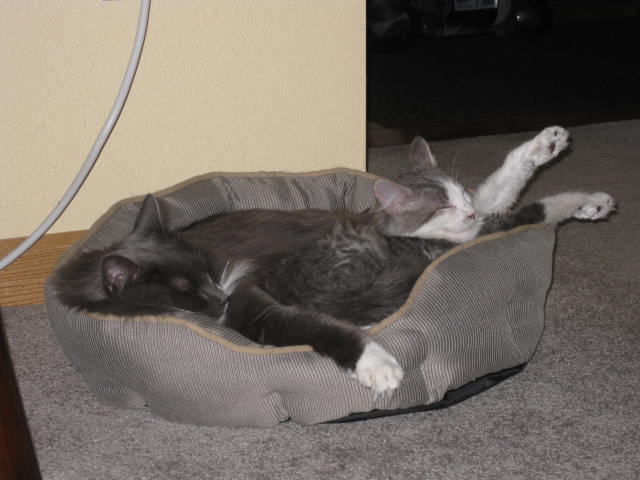
With Riley and Stella it took 3 ½ weeks to go from high stress drama to sleeping in a cat bed (together!!!!) on a cold, snowy afternoon. There were several days/weeks I thought it was never going to work out, but I'm so grateful that I stuck it out and gave each cat the necessary time to adjust.  I have to say that it's really worth the time and effort that goes into the integration process when you see them actually playing "nicely" together and taking naps in a sunny spot side-by-side.


Saturday, January 15, 2011

Nomi's Christmas Miracle

Early Christmas Eve morning our receptionist took a call from a non-client interested in euthanizing their dog. They set the appointment for later that afternoon. Upon arrival at Care, we were surprised to see that Nomi was a 6 month old pit bull puppy full of energy and love.  We learned that these owners had trouble keeping Nomi enclosed with their back yard fence.  They did not want to have Nomi run loose in the neighborhood—they thought that euthanasia was their best option.  Dr. Garnett convinced them to instead relinquish Nomi to Care Animal Hospital so that she could find a new home.

Tiann, one of Care’s exam room assistants, has a soft spot for all dogs bully. As she passed Dr. Garnett in the treatment area, Dr. Garnett said, “Merry Christmas Tiann, I got you a puppy!” Because it was a holiday, Care was closing early Christmas Eve and would be closed Christmas Day. Tiann decided to take Nomi home for the holidays.


Nomi fit right in at Tiann’s house! She spent her days there playing tug with Tiann’s sister’s dog Layla, and trying to convince the cats that they wanted to play with her! Tiann worked with Nomi everyday, and she has turned into a dog that any family would be lucky to have.

As fate would have it, Nomi’s Christmas Miracle was her people making an appointment at Care. It is horrible to think that her life could have potentially ended, or ended up very differently if she had gone somewhere else that Christmas Eve afternoon.